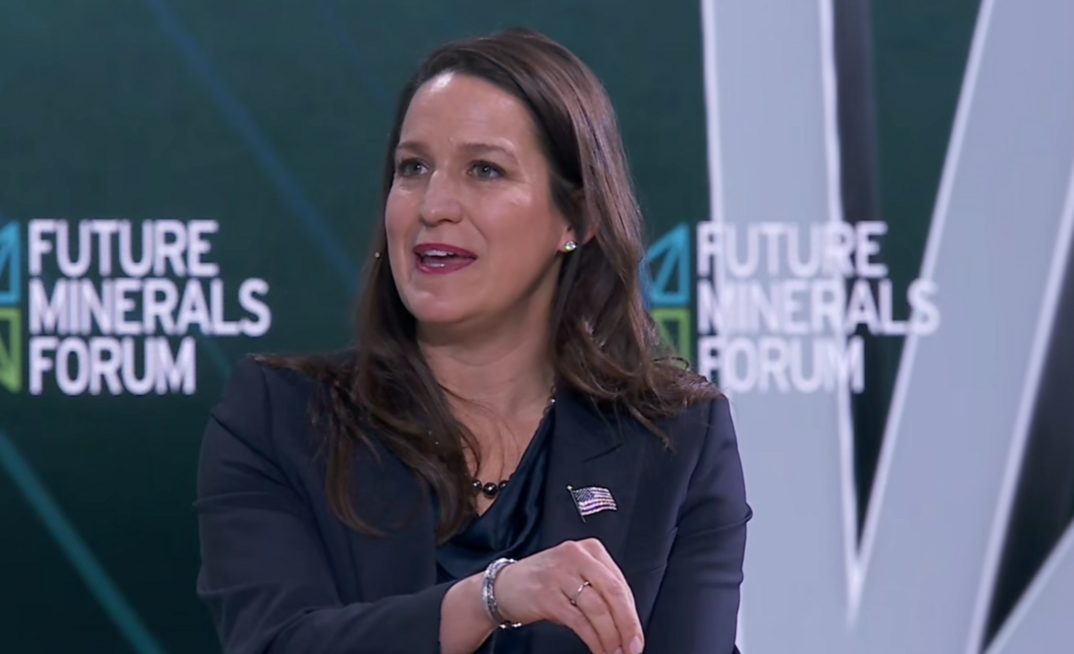


Senior officials from the US and the Democratic Republic of Congo (DRC) used this morning's opening panel at the Future Minerals Forum (FMF) to defend Washington's critical minerals strategy, addressing 'land-grab' criticisms.
Audrey Robertson, the US Assistant Secretary of Energy for Energy Efficiency and Renewable Energy, said that she stood behind President Trump's recent statements on Greenland.
"The President has been decisive in protecting American interests and protecting the interests of our allies," she said.
"This is a capital-intensive industry [...] To be successful, you have to have long timelines, you have to have strong partnerships, and you have to have the ability to invest across borders around the world and with partners you can trust."
YOU MIGHT ALSO LIKE
Robertson pointed to a "landmark agreement with the Kingdom [of Denmark] just a few months ago around critical mineral security". While declining to comment directly on ongoing issues around Greenland, she made clear that critical minerals policy was now central to US foreign and economic strategy.
Turning to the structure of that strategy, Robertson rejected suggestions that Washington was building a sovereign wealth fund through equity investments. "The equity form isn't an underpinning of a sovereign wealth fund," she said. "It is a mechanism to deliver value for American taxpayers."
She said equity stakes were, in some cases, "the most important and strategic way to partner with private industry", citing collaboration between governments and companies to expand refining capacity.
Robertson added that the US was deploying its national laboratory system to maintain technological leadership. "My office alone has committed over a billion dollars in the last several months," she noted.
US-DRC: "Win-win"
Another US-led minerals partnership to draw criticism is the framework agreement signed between Washington and Kinshasa. Moderating the session, British journalist Becky Anderson asked whether the deal risked appearing lopsided or could foster mistrust among other global partners.
Robertson dismissed claims of coercion. "The US seeks to have great partnerships, where we all bring different things to the table," she said. "Partnerships are a two way street. There's no strong-arming, there's only strategic alliances to better our nations and better the world."
Sitting alongside Robertson, Louis Watum Kabamba, the DRC's Minister of Mines, pushed back strongly against claims that his country was conceding too much.
"It's not true at all," Kabamba said. "When we signed the deal in December in Washington, it was not about selling our resources for nothing. It was a framework [...], and it's got to be a win-win partnership."
Kabamba said the DRC had undertaken "real efforts and strong reforms" to improve governance, predictability and traceability, and argued that negative perceptions no longer reflected reality. He pointed to more than US$45 billion in existing mining investment and the recent commissioning of major processing infrastructure.
"Your best allies are not President Félix [Tshisekedi] or myself," he said. "Your best allies are the laws and regulation of the country. They give you security of tenure, they protect your investments."
He acknowledged major infrastructure constraints, with logistics consuming "nearly 30% of your operating cost" and a power deficit exceeding 1,000 MW, but said the country's mineral wealth made long-term investment viable.
"When a country has a mineral endowment of nearly US$25 trillion," Kabamba said, "I don't think it's too difficult to raise the finances for that."