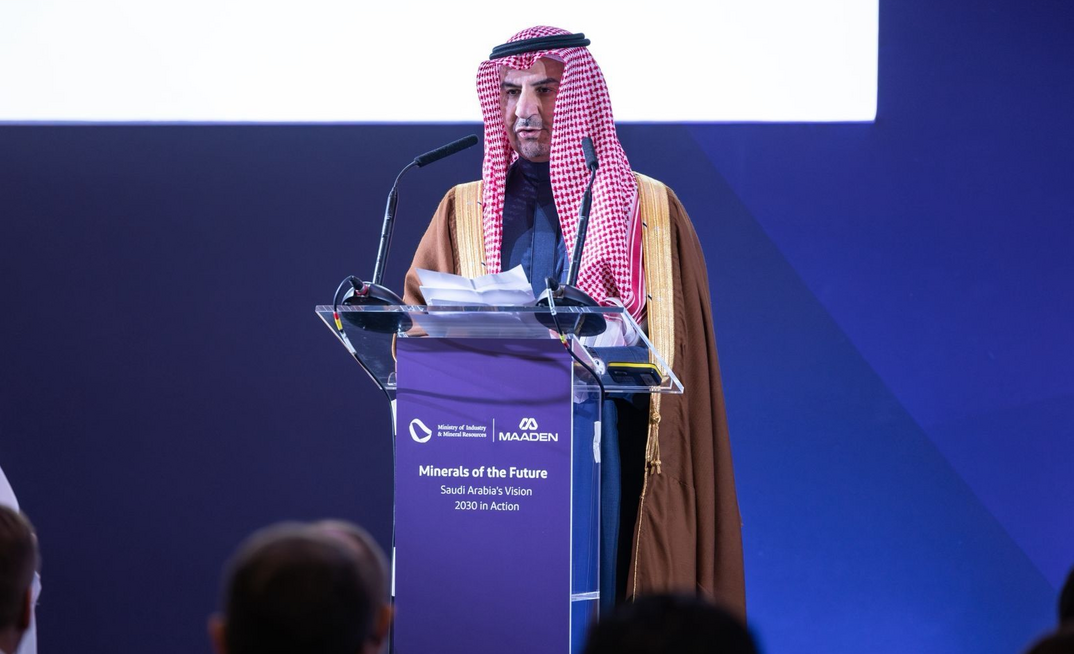


Khalid Al Mudaifer has a way of making the radical sound somewhat modest.
Sitting in London during LME Week, the Saudi vice minister for industry and mineral resources for mining affairs spoke to Mining Magazine about one of the most ambitious industrial undertakings in the kingdom's modern history.
"We have done so little [mining] in Saudi Arabia," he said about the domestic industry. Yet what followed was the portrait of a sector expanding with unusual speed and intent.
Despite being a fairly young industry, mining is now at the centre of Saudi's Vision 2030, the government's strategy to diversify revenues and industries. "We are diversifying under Vision 2030 and one of the sectors that will be used to do so is mining," Al Mudaifer said.
YOU MIGHT ALSO LIKE
The transformation has been rapid. "We began with just one company, Maaden, then grew to three or four. And now we have 226 companies working last year."
Millions are being spent
From a near-standing start, Saudi Arabia has built one of the fastest-growing mining jurisdictions in the world. According to the Ministry of Industry and Mineral Resources, exploration spending reached SR 1.05 billion (US$280.5 million) in 2024, a fivefold increase since 2020.
Private-sector investment in exploration licences rose from SR 155 million ($41 million) in 2020 to SR 770 million ($205 million) in 2024, while government spending through geological programmes increased from SR 11 million ($3 million) to SR 180 million ($48 million).
The number of exploration companies operating in the country has jumped from six in 2020 to 226 in 2024 over the same period.
"Saudi Arabia's mining sector is entering a new phase of accelerated growth and maturity," Al Mudaifer said. "Progressive legislation, focused national programmes, and transparent, sustainable partnerships" have been key to that shift.
The government's geological survey efforts have concentrated on the Arabian Shield, a mineral-rich formation that stretches across the western half of the country.
Early estimates point to resources of 67 Moz of gold, 3.87 Mt of copper, and 5.24 Mt of zinc. More than 70% of the country's exploration spend last year went into new and underexplored areas, reflecting the government's longer-term approach to discovery.
The economic lens
What sets Saudi Arabia apart, Al Mudaifer said, is that mining is not simply about revenue for the country.
"For Saudi, mining is not a fiscal play. It is an economic play. Most countries want to mine for money. We are mining to add to our economy, to create jobs, to further development."
To attract investors, the government has focused on data transparency and early-stage support. "We are also doing a number of things like providing data," he said, referring to the Saudi Geological Survey's national database and its Regional Geological Survey and Accelerated Exploration programmes.
These initiatives aim to reduce risk for investors and create a comprehensive geological map of the kingdom.
The result has been a sharp rise in foreign participation. Two-thirds of bidders in the country's latest exploration tenders were from abroad, including from Australia, Canada, China, India, Indonesia, and the United Kingdom. Foreign investment now accounts for 66% of total mining investment.
Addressing a major concern for international investors, Al Mudaifer said that "Saudi Arabia has changed. We have moved a lot on ease of doing business."
Processing pie
He also addressed the question of value addition.
During LME Week, a panel attended by Saudi Arabia's deputy minister for mining development, Turki Al Babtain, was asked how the supply chain can be balanced if resource-rich countries want to retain more value, and resource-poor countries want to build processing capabilities to retain a piece of the 'critical' mineral pie.
Al Mudaifer's answer to this was that "everyone should retain maximum value. However, this doesn't only mean processing."
"Every country should do what they are good at. For Saudi Arabia, we have capital and the ability to build a mining industry, to invest. Other countries have minerals. The important thing is that every country gains from what they have."
Infrastructure abroad
This approach is already being tested abroad by Saudi Arabia. At the PERUMIN 37 Mining Conference in Peru earlier this year, Saudi officials highlighted the kingdom's mining reforms and its intent to build partnerships in Latin America.
Abdulrahman Al-Belushi, the deputy minister for mining resource development, said both Saudi Arabia and Peru see mining as a driver of economic growth and a contributor to energy transition goals.
In Brazil, the Saudi mining company Maaden announced plans to invest about BRL 8 billion ($1.5 billion) in geological mapping, research, and mineral development.
The project, supported by Brazil's Ministry of Mines and Energy, will involve the establishment of Maaden's first South American office in São Paulo. Brazilian minister Alexandre Silveira described it as a "significant opportunity" to strengthen sustainable and responsible mining, adding that "there is no energy transition without mining."
These moves illustrate Saudi Arabia's broader interpretation of "value addition," which includes investing in infrastructure and partnerships that reinforce global mineral supply chains. The strategy allows it to export capital and expertise while embedding itself in the industries needed for the energy transition.
Late, but on time
Back home, the same logic applies. Mining exports have risen by about 86% in recent years, led by phosphate, iron, aluminium, copper, and gold. Total current and planned investment in the sector now stands at SR 170 billion ($45.3 billion).
New digital licensing systems, such as the Ta'adeen platform, and funding programmes offering up to SR 7.5 million ($2 million) per project for early-stage explorers, are designed to ensure that smaller players can participate.
Saudi Arabia's argument is that its late arrival to mining is an advantage. "We don't have a legacy of mining, and mining that has harmed the environment or people," Al Mudaifer said.
"We started fresh, mining with Maaden, and with the sustainability focus." The absence of a troubled past has made it easier to design a cleaner, data-driven framework from the outset.