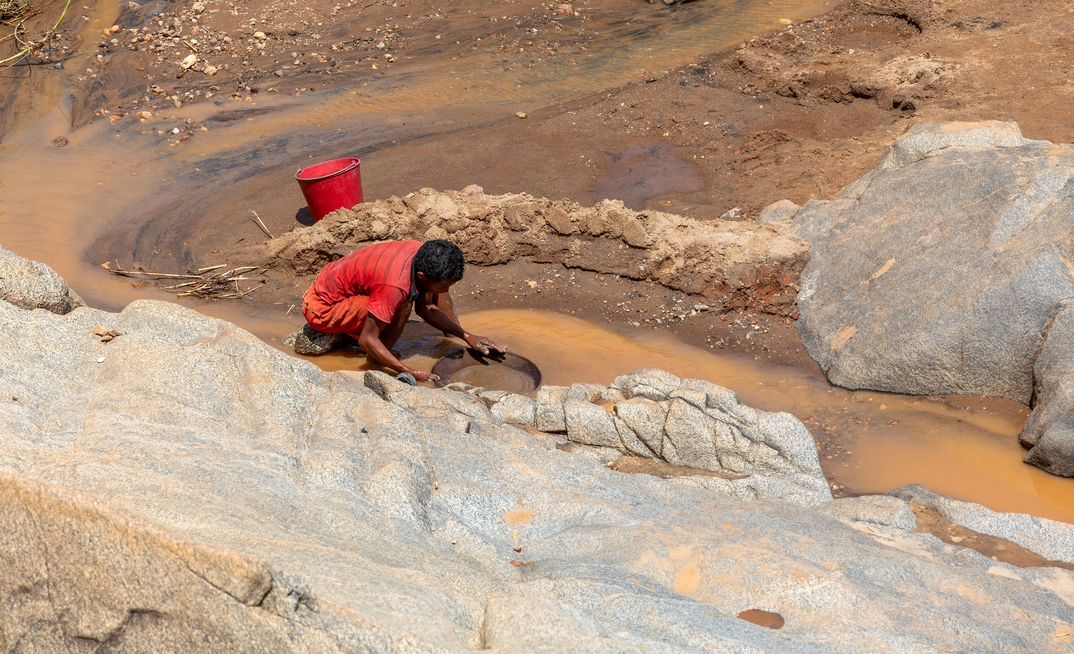


While some might see artisanal and small-scale mining (ASM) as a problem to be solved or cracked down on, Brooke Bibeault has a very different take.
"It is a huge untapped opportunity that could potentially be commercially viable when done right," she said.
Speaking to Mining Magazine, the chief executive of Makor Resources explained why the company has developed Mine Hive, a digital platform that will allow ASMs to share knowledge, access resources, and connect with larger mining entities.
Makor Resources, which has been around for about five years now, has developed its own portfolio of copper and critical mineral assets in Africa, along with partnering with junior and mid-cap miners, investors and governments on responsible mining projects.
That work has included taking a small-scale mine and building it into a 100,000t operation for a listed entity.
"We are growing, and the main thing for us was to find a way to continue to support the artisanal and small-scale sector, because that is very much the ethos of how Makor started," Bibeault said.
The idea was to facilitate a two-way communication channel between ASMs and larger enterprises.
Chief operating officer Ricus Grimbeek said: "The opportunity that we've identified and that we've been working with is very important for small scale miners, and it's very important for artisanal miners, but it's also important for large scale mines, because mining has a PR problem, and the issue with small scale and artisanal mining is that it's part of mining.
"It needs to be done responsibly, and it needs to be done in a way that deals with issues like child labour, community development and environmental impacts."
The idea was born from a meeting in Malawi with Chiko Manda, who has worked for a long time in small-scale mining.
The three saw an opportunity to join forces and improve the lives of miners working in this field.
"Small-scale miners are often not taken seriously, but this is a sector which employs more than 40 million people globally," he said.
"It is very significant, and it is transforming a lot of communities and local economies.
"But there is a missing link somewhere between the authorities and large-scale miners and the small-scale miners."
He said Makor Resources wanted to make sure ASMs were treated fairly and recognised for the positive impact they make on communities.
"We need to put them into the mainstream economy, through formalising their minerals through blockchain technology so their operations are traced from mine to market."
Knowledge sharing
While some jurisdictions, such as Zambia where Makor is based, have reasonably robust legislative frameworks for ASMs, the picture can vary. Zambia specifies that small-scale mines are up to 900 hectares, for example, which is a reasonable size, but not everywhere is the same.
Mine Hive is designed to create a community where ASMs from different regions can share knowledge and get access to resources, including education, they would normally not be able to reach easily.
"When you are in the field working as a small-scale or artisanal miner, your ability to understand what the market price is is not easy," Grimbeek said.
"You don't have access to wifi, necessarily.
"On Mine Hive, we share the latest prices of commodities daily."
A training event held on November 11 shared information about how ASMs can get financial support for their operations.
One reason this is necessary is that ASMs do not necessarily know how to structure information about their projects in a way that a financial organisation can see clearly and easily what is needed.
For example, a project may be in need of specific equipment to scale up operations, at a certain cost.
"We show them examples of what they need to prepare and allow them to ask questions about things they are unsure about," Grimbeek explained.
This information can include environmental regulations.
"It is like the Facebook of ASM," he said.
People register and create a profile in much the same way as they would for other social media sites.
And Grimbeek said formalisation is not always the end goal.
"It sounds like the right thing, but it's not necessarily the right solution for the local situation that the miners find themselves in," he said.
While these miners might benefit from access to PPE, training and resources, they do not necessarily want to get swept up into the large-scale mining world.
"Why Mine Hive is a game-changer is that it is a multi-country platform where people can share ideas, get inspired and find markets," Manda explained. "It's like an innovation hub where somebody in Zimbabwe can learn from someone in Tanzania, for instance."
While the focus is on Africa for now, the plan is to scale globally.
"It is still growing, but we have already seen the impact of it," Manda said.
Making connections
The platform is available on WhatsApp, meaning that the only equipment needed is a smartphone.
ASMs themselves are being joined by equipment suppliers, environmentalist and financial institutions on Mine Hive.
"When all that knowledge is put together, it creates something which never existed before," Manda said.
His hope is that those using the platform will spread what they learn beyond other users to their communities.
"The broader commitment is to connect all stakeholders across the value chain," Bibeault said. "Right from the artisanal miner to a large operator, to suppliers, drivers, downstream operators and manufacturers."
An app is now being built, though for now users can depend on existing social networks to communicate.
"The barrier to entry is zero," Grimbeek emphasised.
As Mine Hive grows, it will divide into separate channels he said, so that those looking for marketing help can seek the information they need while there will be separate channels for financing and other specialist areas.
The team also has plans to increase engagement with the initiatives of large-scale miners to work with ASMs.
"Compliance is obviously hugely important," Bibeault said, "And these regulatory bodies and governing bodies are critical.
"But that is not only what Mine Hive is about.
"It is about connection and creating a trusted and safe space for the mining community."