

Caterpillar reported better-than-expected revenue of US$17.6 billion, a 10% rise from 2024, as it published its September quarter results today.
The American original equipment manufacturer (OEM) reported a 3% decline in operating profits to $3 billion, as tariffs resulted in an additional $686 million in manufacturing costs.
The OEM's "record" revenue was helped by a $870 million or 17% increase in sales to its energy and transportation business. Now its largest division, it took $8.4 billion in the quarter, driven by growth from power generation for data centres, with a 33% increase.
Shares in the Irving, Texas-headquartered company rose 12% in the first hour of trading on the New York Stock Exchange.
YOU MIGHT ALSO LIKE
Caterpillar chief executive Joe Creed hailed the company's "strong results" for the quarter.
"Our team's continued discipline in a dynamic environment, coupled with a growing backlog, positions us for sustained momentum and long-term profitable growth," he said.
"Despite the tariff headwind, adjusted operating profit margin was slightly above our expectation," he said.
Resource industries
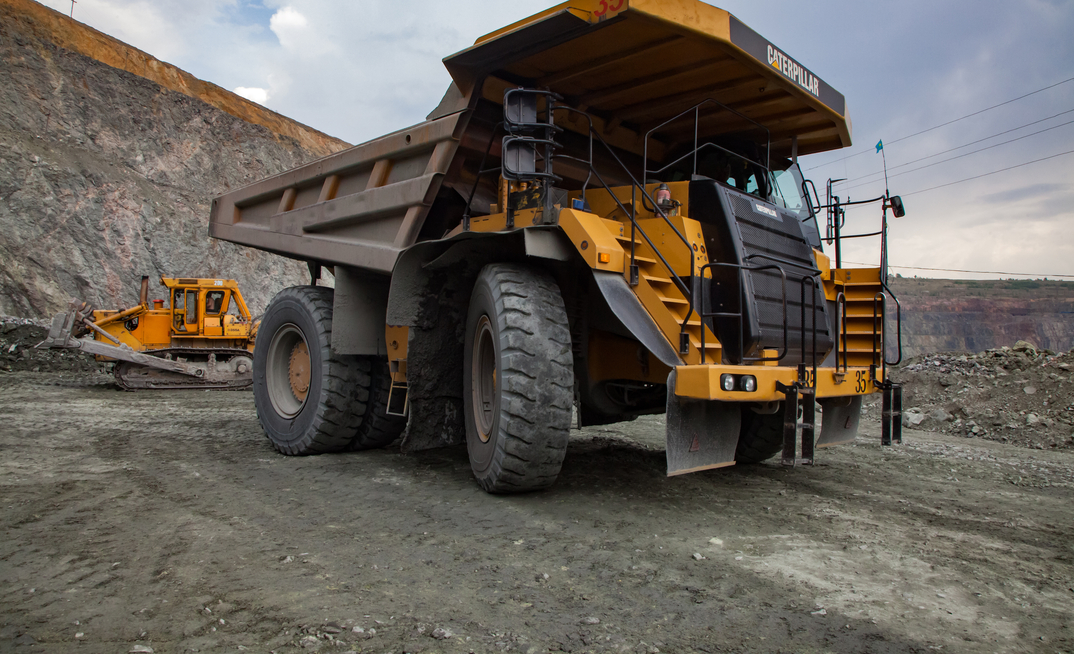
Caterpillar's resource industries division, which provides equipment to the mining, heavy construction, and quarry and aggregates industries, increased sales by 2% to $3.1 billion.
"Mining was better than expected due to the timing of deliveries to end customers for large mining trucks and off-highway trucks," Creed said.
While the resource industries division sold more this quarter, it struggled under $61 million-worth of "unfavourable price realisation" and a $92 million rise in manufacturing costs, seeing profits fall 19% to $499 million.
In North America, the division's sales increased by just 1%, reaching $1.15 billion. Stronger gains were seen in Latin America, where it reported $543 million in sales, representing a 9% year-on-year increase. In Europe, Africa, and the Middle East, sales rose by 22% to 541 million.
But Asia and the Pacific disappointed, as sales fell by 8% to $799 million.
"Order rates are principally around large mining trucks," Caterpillar chief financial officer Andrew Bonfield said.
"With regard to autonomy, we do see a greater acceptance by our customers of the need for autonomous solutions," Bonfield added.
Tariffs hit
"The net impact of incremental tariffs was near the top end of our estimated range of $500 to $600 million," Creed said on the investor call today.
Caterpillar reported that the net incremental effect of tariffs would be between $1.6 to $1.75 billion for the full year.
Creed said that tariff and trade negotiations "remain fluid" and that the company had enacted "no regrets" actions to mitigate tariff impacts.
"We've made limited sourcing changes, where we have the ability to move sources without investments in our supply chain."
"Our team is continuously evaluating options to further reduce the impact of tariffs going forward, and we fully intend to implement longer-term actions once there's sufficient certainty. I remain confident that we'll manage the impact of tariffs, over time," he said.
If we do something that requires investment, I don't want to spend that money and then turn around and spend money to reverse it
Creed said that while Caterpillar was heavily US-based, its global supply chain was "complicated", meaning that longer-term tariff responses would "need to have a greater level of predictability and stability in the situation."
"It's just right now, if we do something that requires investment, I don't want to spend that money and then turn around and spend money to reverse it. So we're trying to take a measured approach," Creed said.
Bonfield said the "tariff headwind should be larger than it was in the third quarter", with a cost of about $650 to $800 million in the December quarter.
"Including the net impact from incremental tariffs, we anticipate a lower margin in resource industries versus the prior year," Bonfield said.
Outlook
Creed said that Caterpillar expected its resource industries division to end the year with lower sales to users compared to 2024 as "customers continue to display capital discipline".
"However, we see positive momentum with healthy orders for large mining trucks, articulated trucks and large track-type tractors," he said
Creed said that most key commodities "remain above investment thresholds," except for coal, which has led to more parked trucks.
"As a result, we continue to expect slightly lower rebuild activity compared to last year."
"Overall, customer product utilisation remains high, and the age of the fleet remains elevated. We also continue to see growing demand and customer acceptance of our autonomous solutions," he concluded.